MecánicaFluidos
Unidad de Docencia e Investigación

DIEn | Departamento de Ingeniería Energética

 
Inicio | Áreas de Investigación | Personal | Laboratorios | Proyectos | Docencia
 
Aerodinámica de trenes| Combustión | Compressible flow | Energía eólica | Cavitación | Flujo sanguíneo


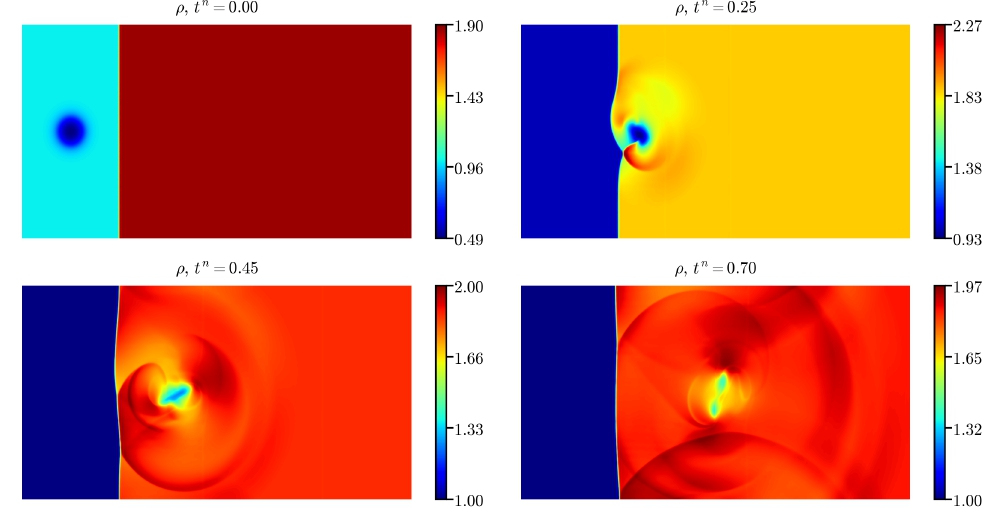
Numerical solution of the shock–vortex interaction problem.


Compressible flow

Description of the area

Compressible flows are present nowadays in many topics of interest. For example, the performance of gas turbines — which are widely used in energy production and in aircraft and shift propulsion — is clearly related to the irreversibilities (shock waves, stall, etc.) experimented by the fluid at the compression and expansion stages. In aeronautics, an effort is being made to reduce fuel consumption and to develop new engines and aircrafts suitable for higher speed flights. Finally, in civil engineering, it is primordial to build factories and industrial warehouses as resistant to explosions (i.e., shock waves) las possible.

The equations that govern compressible flows are known since the mid-twentieth century, but their analytical resolution still remains a challenge for the scientific community. Hence, it is primordial to develop accurate and efficient numerical schemes to approach their study. In this group, we develop finite element methods of Lagrange–Galerkin type, which are characterized for discretizing the convective terms of the equations along the trajectories of the fluid particles, allowing this way for better stability properties. Currently, our work is focused on the following lines:

  • conservative schemes,
  • discontinuity-capturing operators,
  • high-order discretizations on unstructured triangular meshes,
  • hp anisotropic mesh refinement.
 
+Information of the area

Researchers: Manuel Colera Rico, Jaime Carpio Huertas.
Collaborators: R. Bermejo. P. Galán del Sastre, L. Saavedra (UPM), Vít Dolejší (Charles University).

Relevant publications:

1. M. Colera, J. Carpio, R. Bermejo. “A nearly-conservative, high-order, forward Lagrange–Galerkin method for the resolution of compressible flows on unstructured triangular meshes,” Journal of Computational Physics, vol. 467 (2022), p. 111471. doi
2. M. Colera, J. Carpio, R. Bermejo. “A nearly-conservative, high-order, forward Lagrange–Galerkin method for the resolution of scalar hyperbolic conservation laws,” Computer Methods in Applied Mechanics and Engineering, vol. 376 (2021), p. 113654. doi
3. M. Colera, J. Carpio, and R. Bermejo, “A Nearly-conservative high-order Lagrange–Galerkin method for the resolution of scalar convection-dominated equations in non-divergence-free velocity fields,” Computer Methods in Applied Mechanics and Engineering, vol. 372 (2020), p. 113366. doi

Universidad Politécnica de Madrid | Escuela Técnica Superior de Ingenieros Industriales
Departamento de Ingeniería Energética
C / José Gutiérrez Abascal 2, 28006, Madrid, Spain

Secretaría del departamento:

+34 91 06 77180
secdep@etsii.upm.es

 
Unidad de Docencia e Investigación
Mecánica de
Fluidos